San Diego County crash education · desk no. 05
The freeway moves at 70. Your obligations don't wait.
Crashes in San Diego County follow the same California code as anywhere else — but the roads, the reporting offices, and the courts are local. This desk explains collision duties and documentation with San Diego's geography in mind. No invented numbers, no advice dressed as information.
Call 911 for injuries. This site does not give legal advice.
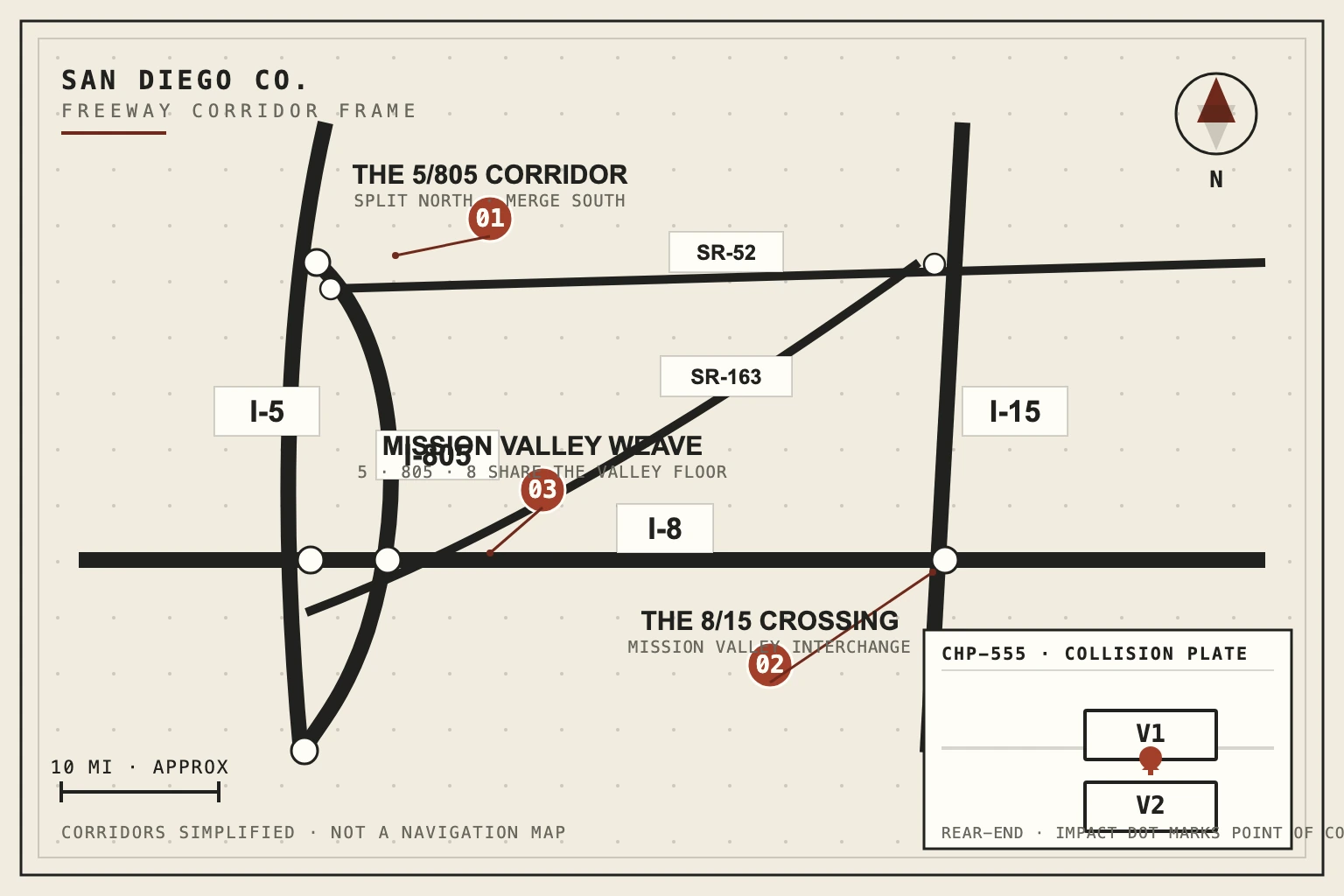
- 01The 5/805 corridor — the coast route and its inland twin split north of Mission Valley and rejoin near the border.
- 02The 8/15 crossing — the east-west spine meets the interior north-south route at the Mission Valley interchange.
- 03Mission Valley weave — where 5, 805, and 8 share the valley floor; merges and exits sit within a mile of each other.
Four facts that cover most of it
Each carries its source. Every topic page expands on these — with the same grounding rule: no invented numbers.
Stop, exchange, report.
California law makes stopping and exchanging information a duty after any collision — not a courtesy. Injury or death adds a duty to report to law enforcement.
SRC: Cal. Vehicle Code §§20001–20004Ten days for the SR-1.
A collision with injury, death, or property damage over $1,000 means a written SR-1 report to the DMV within 10 days — whether or not police responded.
SRC: Cal. Vehicle Code §1600030/60/15 since 2025.
For policies issued or renewed on or after January 1, 2025, California's minimum liability limits are $30,000 per person, $60,000 per accident, and $15,000 property damage.
SRC: SB 1107 (Stats. 2022, ch. 717); Cal. Veh. Code §16056Two years to file.
A personal-injury lawsuit must generally be filed within two years of the injury. Narrow exceptions exist; applying one to a specific case is a lawyer's job.
SRC: Cal. Code Civ. Proc. §335.1Topics, in reading order
A ledger, not a blog. Start with the crash file, end with the timeline — each file stands alone, each links to the next logical one.
The crash file: one folder, four parts
Every later decision — by an insurer, an adjuster, or a court — is made from records created in the days after a collision.
Fig. 2 — The four-part crash file, as this desk defines it
- Crash record — the police report (CHP-555 on freeways), photographs, and the SR-1.
- Medical record — exam notes, imaging, and treatment logs, kept week by week.
- Loss record — missed work, out-of-pocket costs, and the receipts that prove them.
- Statement record — your own dated notes. Memory fades; a dated note does not.
Three dates structure the first two years
The calendar is not the claim — but the calendar structures the record, and the record supports the claim.
Scene duties
Safety first, then evidence: exchange information, photograph everything before it moves, and note who saw what.
The SR-1 is due
The written report to the DMV, required after injury, death, or damage over $1,000 — separate from the police report.
The filing deadline
Two years from the injury for a personal-injury lawsuit under CCP §335.1 — the horizon the whole record points at.
Editorial standards, stated plainly
This is a reference publication. What that commits the desk to — and what it rules out.
Every claim carries a source
Statutory statements map to public primary sources, listed at the foot of each file. No invented statistics, averages, or anecdotes.
No one sponsors a word
No advertising, no referrals, no affiliate links, no paid placement. The desk has no client to please.
Errors get fixed on the record
The corrections policy and editorial method are published on the About page. No silent edits.